Fuelling business growth through strategic data solutions and partnerships.
For two decades, every business question that required data followed the same path: someone in Finance or Marketing submitted a request, waited days or weeks for the data team to write a query, then asked follow-up questions that restarted the cycle. The data team became a bottleneck not because they were slow, but because the architecture demanded it.
That era is over.
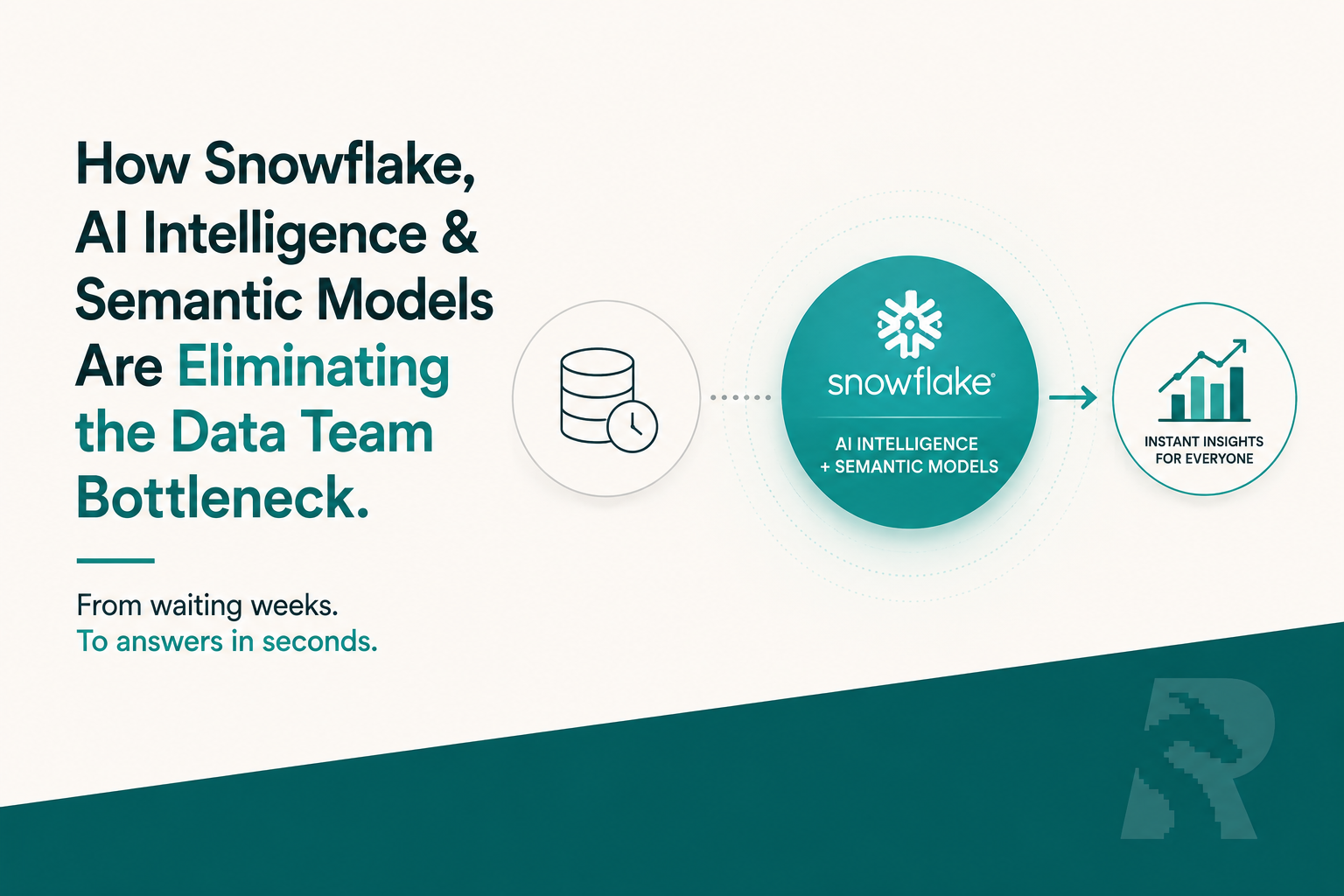
What we're deploying for our clients right now, using Snowflake's AI Intelligence layer built on properly designed semantic models, is a revolution in how enterprises interact with their data. Finance directors are asking questions in plain English and getting governed answers in seconds. Marketing teams are exploring customer segments without writing SQL. Insights that took a week now happen in real time, by the people who actually need them. This is production, today.
Most enterprise data environments suffer from the same problem: the gap between what the data looks like in the warehouse and what business users actually mean when they ask a question. When a CFO asks "what's our revenue by region this quarter?", the answer lives in tables with cryptic column names, complex joins, and business rules that only the data team understands.
The semantic model closes that gap. It's a translation layer that defines what "revenue" actually means, which tables to join, which filters to apply, and how metrics are calculated, in a single, governed, reusable definition. Build it once, and every tool, every dashboard, and every AI agent will produce the same answer to the same question. No more conflicting numbers. No more two teams calculating the same metric differently.
At Rapida, building semantic layers has been a core principle of our architecture practice for years: centralise business logic in the warehouse, define it once, make it available to every consumer downstream.
What's changed is that Snowflake has now made the semantic layer a native, first-class object inside the platform. Snowflake Semantic Views allow you to define tables, columns, metrics, joins, and business logic directly inside Snowflake as a governed database object, just like a table or a view. These definitions are then readable by both BI tools and Snowflake's Cortex AI, meaning the same business logic powers your dashboards and your AI-driven natural language queries simultaneously.
And in late 2025, Snowflake went further by launching the Open Semantic Interchange (OSI) initiative, an open-source collaboration with partners including dbt Labs, Google, Amazon, Sigma, and dozens of others. OSI creates a vendor-neutral, open standard for defining and exchanging semantic metadata. Before OSI, every BI tool and AI agent had its own way of understanding business definitions, and the same metric could be calculated differently across tools without anyone noticing. OSI establishes a common specification: define your semantic model once, in an open format, and every tool in the ecosystem reads it consistently.
The connection is direct: Snowflake Semantic Views are the implementation, OSI is the open standard that makes them portable. The semantic models we build for our clients in Snowflake today are not locked into a single vendor. They're interoperable, governed, and future-proof.
A semantic model on its own creates consistency and governance. But when you layer Snowflake's Cortex AI on top of a well-built semantic view, something transformational happens: business users can talk to their data in plain language and get accurate, trustworthy answers without any technical intermediary.
Cortex Analyst reads the semantic view to understand the business context, metric definitions, table relationships, and calculation rules. When a user asks a question in natural language, it translates the question into optimised SQL, executes it securely, and returns the answer. The AI doesn't hallucinate definitions or guess at join paths, because the semantic view has already encoded the ground truth.
This is the critical difference between AI that sounds good in a demo and AI that works in production. Without a semantic layer, text-to-SQL is unreliable. With one, the AI knows exactly what you mean.
Here's a quick look at what this experience looks like in action:
Snowflake AI chat in action: business users asking questions in plain English, powered by semantic models.
Finance teams are self-serving. A Finance Director who used to email the data team every Monday can now ask the question in plain English and get the answer in seconds, with the same governed definitions that the official reports use. Ad-hoc requests hitting the data team have dropped dramatically.
Marketing teams are exploring, not waiting. Campaign analysts who needed a data engineer to build a segment can now query customer behaviour directly. "Show me customers who ordered more than three times last month but haven't ordered in two weeks" is answered on the spot, using the same business rules that power the official dashboards.
Insights have exploded. When the cost of asking a question drops to zero, people ask more questions. We're seeing clients generate 10x more ad-hoc queries, not because they have more data, but because the friction of accessing it has been removed. The real value lives in the questions people weren't asking before.
The data team is elevated. When business users self-serve routine questions, the data team stops being a query factory. They focus on what they should have been doing all along: building better models, improving data quality, developing AI capabilities, and architecting systems that scale.
The AI layer is only as good as the semantic foundation it reads. Our approach:
Data centralisation. Consolidate fragmented sources into a single Snowflake platform with proper modelling, governance, and data quality controls.
Semantic model design. Working with Finance, Marketing, and Operations, we define the business logic as Snowflake Semantic Views: what each metric means, how it's calculated, and how entities relate. This is where business knowledge matters most. A semantic model built by someone who doesn't understand the business will encode the wrong definitions, and the AI will confidently give wrong answers.
Snowflake AI activation. With semantic views in place, we deploy Cortex Analyst and configure natural language interfaces, embedded analytics, and integrations with Slack and Microsoft Teams.
Governance and iteration. Semantic models are living artefacts. We build the governance framework to keep them accurate, versioned, and aligned with the OSI standard for long-term interoperability.
Previous waves of analytics innovation each improved the speed of data access. But none fundamentally changed the interaction model. Business users still needed to know which dashboard to open or which report to request.
With Snowflake Semantic Views as the foundation, OSI as the open standard, and Cortex AI as the interface, the model flips entirely. Business users don't go find the data, they ask a question and the data comes to them, in their language, governed by centrally defined logic. This isn't a better version of the old model. It's a new model entirely.
The organisations that adopt it first will have a structural advantage: faster decisions, lower cost of insights, and a data team that operates as a strategic asset instead of a service desk.
At Rapida, we've been building semantic layers and AI-powered analytics architectures for enterprise clients across 44 countries. We understand the data, we understand the business, and we know how to get this into production fast, starting with a POC that proves the value.
The revolution is here. The question is whether you lead it or watch it happen.
Learn more at rapida.solutions