

Why a Strong Data Strategy Is the Foundation for AI Success
Artificial Intelligence (AI) is reshaping industries, enabling businesses to make smarter decisions, automate processes and uncover new opportunities.
However, many organisations rush into AI initiatives without addressing a critical prerequisite: a solid data strategy.
Without properly governed, organised and high-quality data, even the most advanced AI systems will fail to deliver reliable results.
At Rapida Solutions, we emphasise that successful AI begins with a well-thought-out data strategy. This involves aligning governance, architecture and processes with business goals before advancing to techniques such as data modelling and quality monitoring.
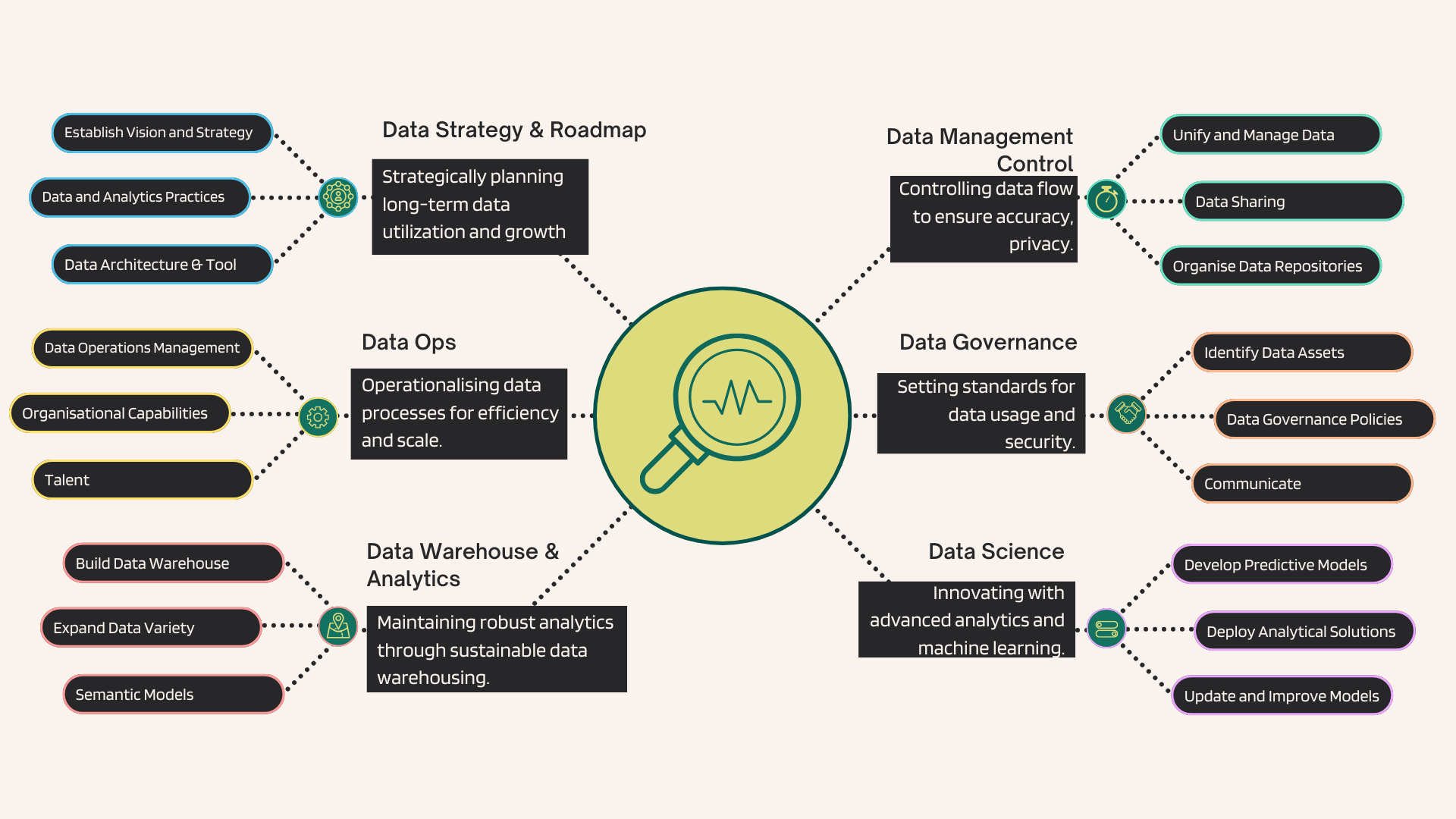
Building a Comprehensive Data Strategy
A robust data strategy ensures that data is not only collected, but also managed and maintained in a way that supports both current operations and future AI initiatives.
A successful data strategy typically includes the following components:
1. Data Governance
Establish policies and controls to ensure consistent management of data across the organisation. This includes defining ownership, ensuring compliance with regulations and setting standards for secure access and usage.
2. Data Architecture
Design scalable platforms such as data warehouses or data lakes that integrate structured and unstructured data from multiple sources.
A well-designed architecture ensures seamless data flow and accessibility.
3. Data Management
Implement processes for collecting, storing, transforming and maintaining data throughout its lifecycle.
Effective management reduces redundancy and ensures datasets remain relevant over time.
4. Data Quality
Continuously monitor for duplicates, missing values, outdated records and inconsistencies.
Poor-quality data can significantly impact AI performance. Research suggests that up to 80% of an AI project's effort is often spent preparing and cleaning data.
Tools such as Rapida Data Guardian help automate quality checks and maintain accuracy over time.
5. Data Controls and Security
Protect sensitive information through robust access controls and security protocols.
This helps ensure regulatory compliance while reducing the risk of breaches and misuse.
6. Scalability
Ensure your infrastructure can support increasing volumes of data and more advanced AI use cases as the business grows.
7. Data Accessibility
Provide stakeholders with intuitive tools that enable self-service analytics and faster decision-making without excessive reliance on IT teams.
8. Data Literacy
Build a culture where employees understand the value of data and are equipped to interpret and use insights effectively.
The Role of Data Modelling
Once governance, architecture and management foundations are in place, organising data into structures that support analysis becomes critical.
This is where dimensional modelling plays a key role.
Dimensional models organise data into:
Facts – measurable metrics such as sales revenue, transactions or website visits.
Dimensions – categories such as time, location, products or customer attributes.
This structure makes it easier to analyse trends, identify patterns and generate actionable insights through both traditional reporting and AI-driven analytics.
Examples include:
Analysing sales performance by region and time period to predict demand.
Optimising logistics operations using historical traffic and delivery patterns.
Understanding customer behaviour across channels and segments.
Why Data Quality Requires Continuous Attention
Even with governance and modelling in place, maintaining high-quality data remains an ongoing challenge.
Duplicate records, missing values and outdated information can gradually erode trust in analytics and AI systems.
Poor-quality data often results in inaccurate predictions, flawed decision-making and reduced confidence in business insights.
Continuous monitoring is essential to identify issues before they impact operational or strategic decisions.
Rapida Data Guardian automates quality checks and anomaly detection, helping organisations maintain reliable datasets over time.
Garbage In, Garbage Out
The principle of "Garbage In, Garbage Out" remains highly relevant in the age of AI.
If input data is inaccurate, incomplete or poorly structured, the outputs generated by analytics and AI systems will also be flawed.
One increasingly common example is AI hallucination, where AI models generate responses that appear credible but are factually incorrect.
These issues are often rooted in poor data quality, inconsistent definitions or weak governance processes.
Conversely, organisations that invest in strong data foundations benefit from:
Better governance and compliance
More reliable analytics
Higher-quality AI outputs
Faster decision-making
Greater trust in data-driven processes
How Rapida Solutions Can Help
At Rapida Solutions, we help organisations transform fragmented and inconsistent datasets into trusted assets ready for analytics and AI.
Our solutions include:
Rapida Data Layer – Pre-built semantic models that accelerate dimensional modelling and analytics.
Unified Data Hub – Consolidates siloed data into a single source of truth.
Rapida Data Guardian – Automates data quality monitoring and anomaly detection.
Rapida Data 360 – Comprehensive data strategy assessments covering governance, architecture, quality and maturity.
Our assessments identify gaps, prioritise opportunities and provide practical recommendations aligned to your business objectives.
Ready to Build Your Data Strategy?
AI success doesn't start with algorithms. It starts with data, and more importantly, with a strategy for managing that data effectively.
At Rapida Solutions, we help organisations build the foundations required to unlock the full value of analytics, AI and modern data platforms.
Contact us to learn more about our services or to discuss where your organisation currently sits on its data maturity journey.