
Context. It's the biggest Data and AI news of 2026. Not some new model.
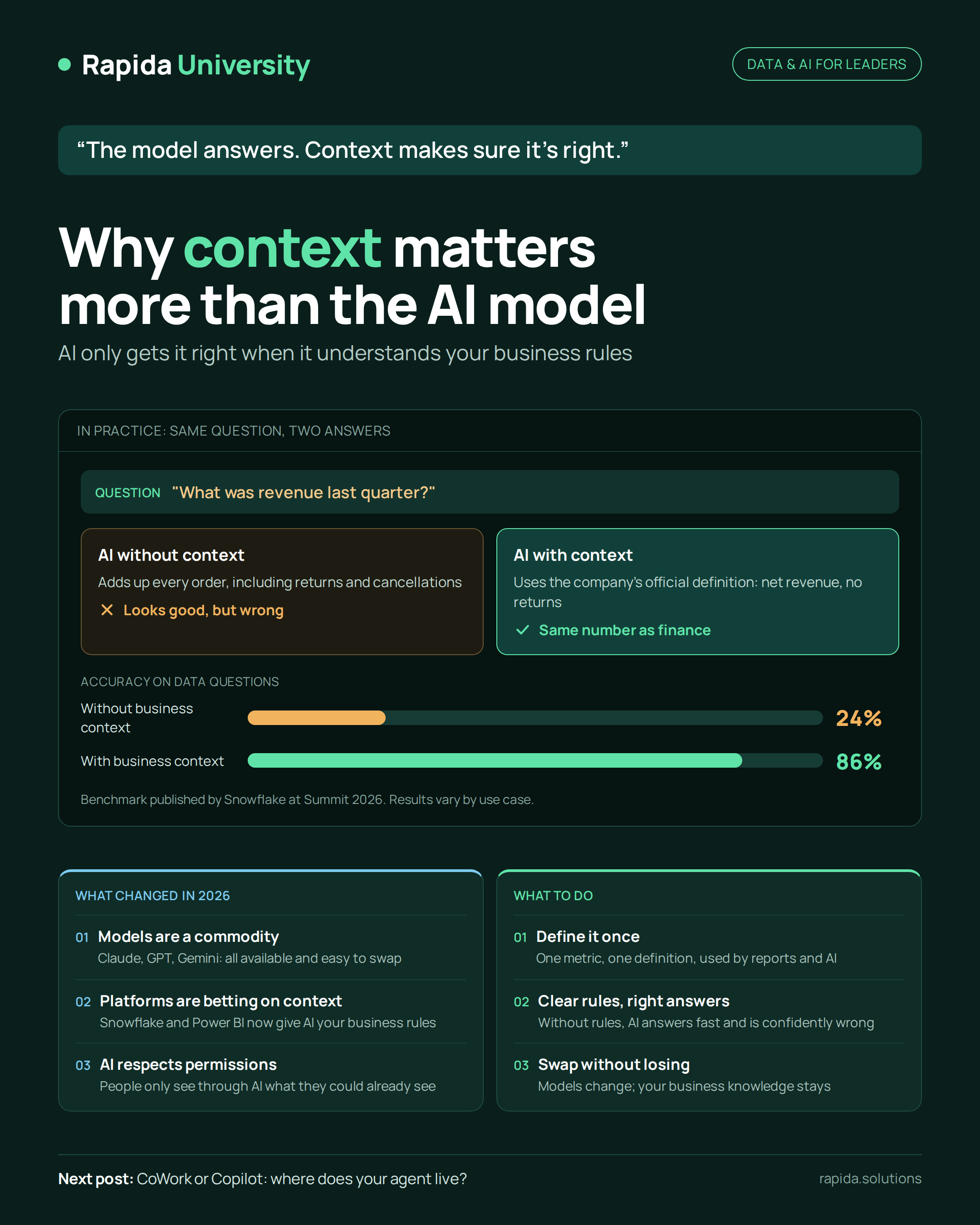
"24% accuracy without business context."
That's what Snowflake reported at Summit 2026. It's the accuracy for AI models trying to answer basic business questions. Alarming? It should be. We're all excited about AI's potential, but many businesses are hitting a wall. And it has nothing to do with algorithms or processing power. It's about understanding what "revenue" actually means to them.
Forget the hype around the newest AI model. The biggest data and AI news of 2026 isn't some revolutionary architecture. It's the stark realization: context is king.
Your AI Isn't Smart Without Your Rules
Ask an AI model a simple question: "What was our revenue last quarter?"
Without specific instructions, it'll probably do what you expect. It'll scan all your sales data, sum every transaction, maybe even include returns. Then, it'll confidently give you a number. That number, while technically an aggregation, is likely wrong. Not because the AI is bad, but because it doesn't know your business rules.
Finance departments don't just add up every order. They apply specific definitions: What counts as revenue? Are returns netted out? Are certain types of transactions excluded? These nuances make a number meaningful. Without them, your AI is fast, but confidently, fundamentally wrong. AI doesn't have a data problem. Businesses do. We see this challenge frequently with clients. The technology is ready, but the definitions are not.
Define Once, Use Everywhere: The Semantic Layer Approach
Both Snowflake and Microsoft are deeply invested in fixing this. At Snowflake Summit 2026, they shared their findings: about 24% accuracy for AI without business context. That jumps to 86% with it. Microsoft is on a similar track, integrating Copilot into Power BI to use the rules already defined in your reports.
What's the real takeaway here? It's not about building a smarter AI model from scratch. It's about building a smarter data environment that feeds your AI. This means:
Defining each critical business metric once. Not in a spreadsheet here, a report there, and a data model somewhere else. One source of truth.
Using that same definition everywhere. From your daily operational reports to your executive dashboards, and yes, to feed your AI models.
Building a robust semantic layer. This is where your business knowledge lives – the definitions, hierarchies, and relationships that give your raw data meaning.
When AI can query this semantic layer, it stops guessing and starts understanding. It stops doing simple sums and begins applying the logic you've already established.
Business Knowledge Outlives Algorithms
AI models will change. New architectures will emerge. Faster processing will become standard. This technology moves at light speed. But your core business knowledge? Your definition of "customer," "profit margin," or "market share"? Those are constants. They are your competitive advantage.
Investing in robust data governance and a well-defined semantic layer isn't just a basic requirement for good reporting anymore. It's the foundational investment that will determine whether your AI projects deliver genuine value. Or if they just generate impressive-looking but ultimately useless numbers.
So, who owns the definition of "revenue" in your company? Because that person, or that team, just became critical to your AI strategy. Without their clear rules, your AI will keep getting it wrong, no matter how clever the model.
https://www.youtube.com/watch?v=V6RshK2twis
Rapida helps businesses build the foundational data platforms and semantic layers that make AI practical and valuable. Facing something similar? Talk to the team.